I recommend you read through the Transformer Info
(Understanding Transformers) page so you understand transformers better if you are not
familiar with them. The Power Supply Design page explains how to build a complete power
supply for a hot wire foam cutter after you have selected the wire and transformer.
This page combines information on how to choose both
the nichrome wire and the transformer for the power supply because the two go together--one
depends on the other.
Wire Measurement
Wire is measured in gauge. There are several
different gauge standards so it is common to use the decimal measurement instead of gauge
now. Nichrome wire and other non-ferrous metals use the AWG gauge standard, American
Wire Gauge, and this is the standard I use on my Web site but I also list the decimal
inches. The AWG is the same as B&S standard, Brown and Sharp. This standard is also used for
copper and aluminum wire so is the same gauge as is used for electrical wiring in your home.
Ferrous wire like iron and stainless steel wire most
commonly use the W&M, Washburn & Moen, wire gauge.
A comparison chart of wire sizes in the various gauge
standards and more information on wire gauges and their origin can be found here:
http://www.sizes.com/materls/wire.htm.
Another useful comparison chart tabulated by decimal equivalent rather than gauge size as
above can be found here:
http://www.dave-cushman.net/elect/wiregauge.html.
As the gauge number gets larger, the wire size gets
smaller. AWG 40 gauge is hair fine while AWG 14 gauge is nearly as large as a
household wire clothes hanger.
What wire size should I use?
You can use any wire size you want to. Foam can
be and is cut with wire sizes from 40 gauge (.003" dia.) all the way up to 11 gauge (.091"
dia.). The most common size is 26 gauge. A short piece of 40 gauge wire has been
used with a 9 volt battery to cut very thin (.020") and narrow strips of foam for
air surfing walk-along gliders.
Two D cell batteries can power a 4" piece of 32 gauge nichrome wire in a small hobby hand
held foam cutter.
A 12 volt power supply will power up to 24" of 26
gauge wire. This would include nearly all table top foam cutters which is the most
common type of foam cutter, and would include small bow cutters. This is why 26 gauge
is the most common. 24 gauge to 30 gauge has also been used for table top models.
16 gauge to 11 gauge is used for foam cutters to cut
shapes such as molding because they are stiff enough to hold a shape rather than being
straight. A 12" piece of 14 gauge nichrome wire requires only 1.9 volts but almost 12
amps. Larger diameter wires are also used for very long cutters such as 8 or 10 feet.
The Tension Factor
All metals expand with heat so the nichrome wire at
cutting temperature also expands and gets longer. Because of this, some method of
keeping tension on the wire is needed in hot wire foam cutters. This is usually
accomplished either with a springy frame that the wire is stretched between or a spring is
used. It is also conceivable that a weight could be used with the wire over a pulley.
Tension on the wire also helps keep it taut so when a little pressure is applied when
cutting foam, the wire stays fairly straight which is necessary for a good quality and
uniform cut.
Because of the need for tension, the smaller the wire
is, the less tension can be applied without breaking or permanently stretching the wire.
Using 40 gauge wire means very little tension is possible and it will be harder to keep the
wire taut when cutting. The longer the wire is, the more pressure needs to be applied
to the wire to keep it straight and taut. This is why as a general rule, the
longer the wire, the thicker it needs to be. There is no length vs. gauge size standard
since theoretically any size can be used at any length with the proper voltage applied and
current capacity of the power supply.
Gauge/Current/Temperature Relationship
The temperature of a straight wire in room temperature
calm air can be calculated. A given temperature will result in a specific current
flowing through a specific diameter wire. It doesn't matter how long the wire is, a
given current flowing through the wire will result in the same temperature. For
example, a 26 gauge wire with 2.1 amps flowing through it will result in 600 degrees F
whether it is 2" long or 200" long.
The bigger the diameter, the more current is required
to heat it to the same temperature. For example, only 0.31 amps will result in 600F in 40
gauge wire, but 11.6 amps is required for 14 gage wire. In addition, the larger the
diameter wire, the longer it will take to reach the equilibrium temperature.
The reason a strait wire reaches a given temperature
and stays there in calm room temperature air is that the current continues to produce more
heat as long as the current flows. At the same time, heat is being transferred away
from the wire to the surrounding air. The hotter the wire is, the faster the heat is
transferred away. The wire reaches its equilibrium temperature when the heat generated
is equal to the heat transferred away.
If you coil the wire, in a tight coil like in heaters,
transfer of heat away from the wire is reduced because there is more wire in a given volume
of air and so the wire will get hotter.
In the same way, a wire in contact with any other
material will change the rate of heat transfer away from the wire. If the material it
is in contact with is a good conductor of heat such as copper, the equilibrium temperature
will be lower because heat is transferred away faster. If the material it is in
contact with is a poor conductor of heat (an insulator) the equilibrium temperature will be
higher because less heat is transferred away. These situations result in complicated
heat transfer equations that are not easily solved. In this case, experimentation is
required to find the right wire and voltage to create the desired temperature.
When used in ovens, kilns and
enclosed heated areas, resistance wire will get progressively hotter as
the oven or kiln gets hotter if the voltage isn't changed. The
equilibrium temperature is based on the surrounding air temperature and
will be a fairly constant DIFFERENCE in temperature between the wire and
air temperature. So if you started out with 28 feet of 22 gauge
wire that was coiled such that the temperature was double that of a
straight wire, it would be around 1200F (316C), a difference of 1130F
between air and wire temperature, if the enclosure air temperature
started at 70F. It the wire would just be turning red at that
temperature. By the time you reached 1400F (760C) enclosure air
temperature, the wire temperature would be 1400F plus the difference of
1130F or 2530F. The wire would melt. For kilns and
other high temperature enclosures, the wire gauge, type, length, coil
dimensions, and voltage applied need to be carefully designed to limit
the wire temperature at the final achieved air temperature to be well
below the melting point, and the apparatus must be designed to turn off
at the target temperature or lower. This is not a trivial design
process and should normally be left to an engineer trained in heat
transfer and electrical design.
Current Created From Applied Voltage
As mentioned above, it doesn't matter what the length
of wire is, a certain current flowing through a given wire diameter will result in a given
temperature in free air. So how is that current created? A voltage applied
across the two ends of the wire create that current. The longer the wire, the more
voltage is required to create the same current. This is due to the difference in the
total resistance of the wire in different lengths.
Ohms Law
Ohms law is required to figure out the current and
voltage relationship. Ohms law states:
V = IR
V is voltage in volts (traditional E is used for
voltage and stands for electromotive force instead of V), I is current in amps, and R is
resistance in ohms. You can rearrange the formula to find the current:
I = V/R
From this you can see that is the resistance goes up,
so does the required voltage to get the same current. The resistance of nichrome wire
is specified in ohms per foot. The longer the wire, the more ohms resistance it has so
the longer the wire, the more voltage is required to push the current through the resistance
of the wire.
What Transformer Do I Need?
Power is calculated by the formula:
W = I2R or W
= VI
A transformer is usually rated in watts or volt amps.
For small transformers, they are essentially the same and interchangeable. You need to
know the power required for your heated wire so you know what size transformer will be
required. To calculate that, you first decide what gauge wire you will use and find
the ohms per foot resistance of that wire. For example, 26 gauge wire has a resistance
of 2.67 ohms per foot. If you are using the wire to cut foam with, the normal
temperature desired is 600F. To allow some flexibility in temperature, figure 800F
(you can always turn it down if you have a variable voltage supply). You also need to
know the length of the wire. Lets say you will use 2 feet. Now you can calculate
the resistance, voltage, and power requirements.
I = 2.6 amps (from the temperature table)
r = 2.67 ohms
R = RL = 2.67 X 2 = 5.34 ohms
V = IR = 2.6 X 5.34 = 13.9 volts
P = VI = 13.9 X 2.6 = 36.1 watts
I = current in amps
r = resistance per foot of the wire in ohms
R = total resistance of wire
L = length of wire in feet
P = power in watts
So you need a transformer that can put out at least
2.6 amps rated at 36 watts or more with an output voltage of 13.9 volts or more. The
closest you can find with that voltage or higher is 24 volts. You can use a dimmer switch to
turn the voltage down (see the power supply design page). You need 2.6 amps so you
have to multiply the required amps times the output voltage to get the power in watts, 2.6 X
24 = 62.4 watts or volt-amps. The closest you can find to 62.4 watts or more is a 24
volt output, 100 watt transformer.
You decide that is too big and you want to use a 50
watt transformer. What can you do? Turn the voltage down? No, that will
reduce the temperature. Make the wire shorter? Maybe. Remember that the current
required is the same regardless of the wire length and a given transformer is limited to a
certain amount of current flowing through its windings regardless of the voltage. The
capacity of the transformer is limited by its ability to transfer heat. The heat is
measured in Watts and is determined by the current and resistance so if neither change, the
watts remains the same. If you turn down the primary voltage to the transformer, the
output voltage also goes down but the resistance of the windings does not change so the
maximum current doesn't change either. Making the wire shorter doesn't change the
current requirement but does change the voltage requirement.
As it turns out, the voltage requirement for 18" of
nichrome wire at 800F is 10.4 volts so instead of a 24 volt output transformer, a 12 volt
output, 50 Watt transformer can be used. The current capability is 50 / 12 = 4.1 amps,
well above the 2.6 amps required. The 12 volt 50 watt transformer has a heavier
winding than the 24 volt output so it can handle twice the current but the whole transformer
is much smaller than the 100 watt transformer.
Transformers - Gauge And Max Lengths
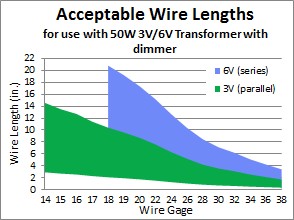
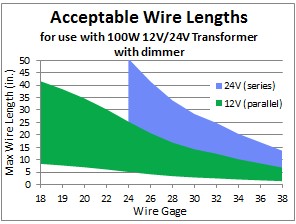
Below are a couple examples from
the 27
transformers I carry now. See the
transformer page where each transformer has its own graph. The graphs show the minimum and maximum length that each
transformer heat to 800F when used with a dimmer for foam cutting. For plastic
bending, the wire should be hotter and so the maximum lengths would be shorter. The
normal foam cutting temperature is 600F but figuring for 800F gives some room for
adjustment. All but one are dual voltages outputs so the lower voltage handles higher
current and so extends the range to larger diameter wires because the current capability is
doubled when the voltage is halved. The higher voltage handles smaller gauge but longer
wire. Dimmers do not go all the way to zero volts, they go to about 20%, so there is a
minimum wire length that can be use.
This transformer can be used with
short pieces of stiffer wire for shaped wire cutting.
 |
This transformer is good for most
table top foam cutters and medium bows using 24-26 gauge
nichrome wire.
 |

